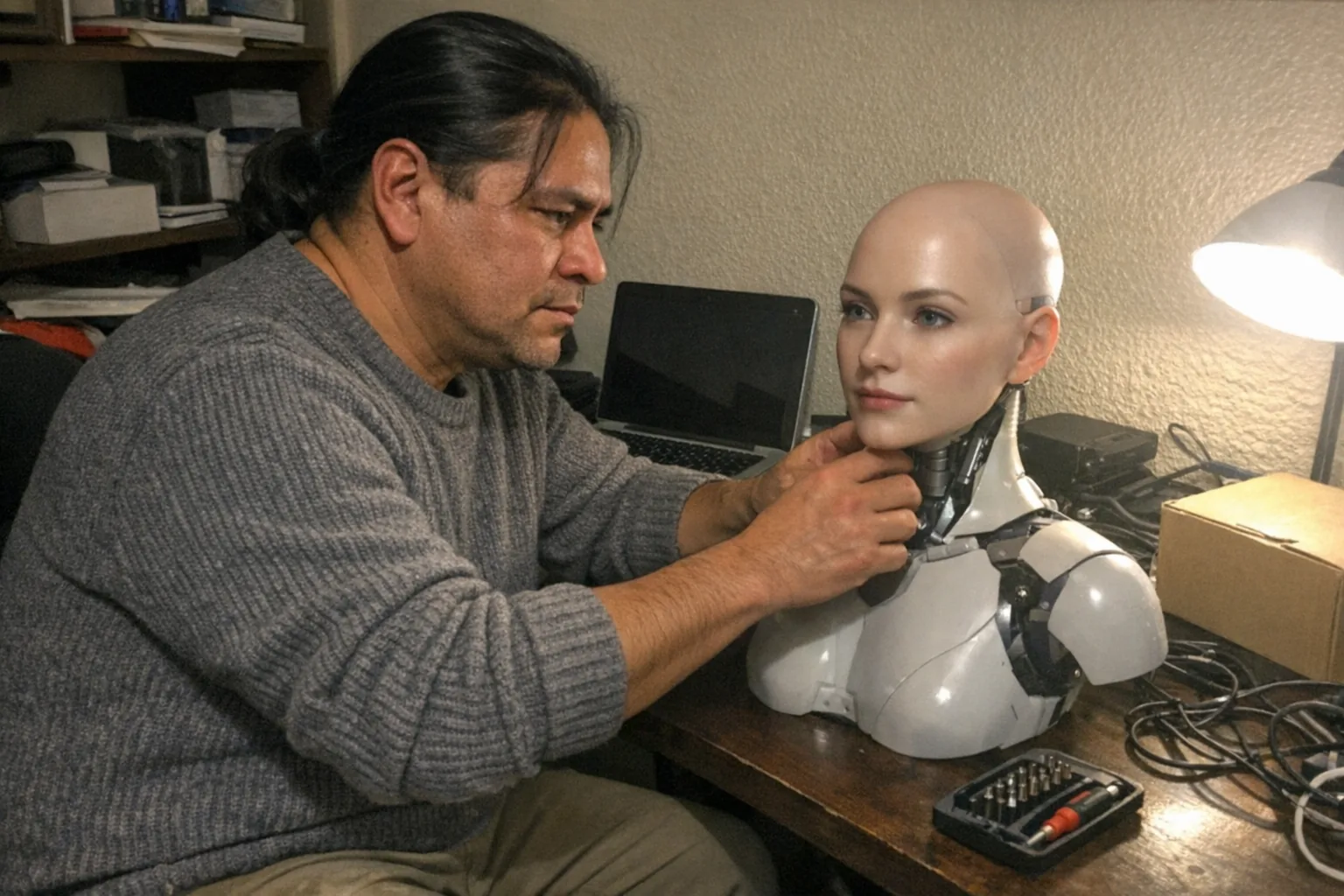
Are female companion robots real?
Yes—female companion robots are real, but mostly in practical, limited forms rather than the fully humanlike, autonomous “robot girlfriends” you’ve seen in movies.
When people ask this question, they’re usually imagining a lifelike humanoid who can hold deep conversations, read emotions perfectly, move naturally, and function safely in a home. That level of general-purpose, humanlike robotics isn’t commercially common yet. What is real today is a spectrum of products that combine some of these ingredients:
- AI companionship (software-first): chat-based “girlfriend”/companion apps with personalities.
- Social robots (robotics-first): friendly robots designed for conversation cues, reminders, and basic interaction.
- Adult-oriented companion devices (hybrid): products that emphasize interactive physical feedback and sometimes integrate with AI or app control.
The key is understanding what “companion robot” means in practice.
What counts as a “female companion robot”?
The term is fuzzy, so it helps to sort it into three buckets:
1) AI companions that feel like a relationship (but aren’t robots)
These are not physical robots—they’re apps or platforms. They can be surprisingly engaging because language models are excellent at conversation, roleplay, and emotional tone.
Realistic expectation: good conversation, “personality,” daily check-ins, memory (sometimes), and a relationship-like dynamic.
Not realistic: true emotional understanding, reliable long-term memory across contexts, or accountability like a human partner.
2) Social robots with “female-presenting” design
Think tabletop or home robots that use voice, a screen/face, and limited movement. Some are explicitly designed with feminine voices, facial styling, or personas.
Realistic expectation: simple conversations, routine assistance, novelty, and a cute/approachable presence.
Not realistic: deep, unscripted relationship behavior or fluid, humanlike movement.
3) Humanoid/anthropomorphic companion robots (the “robot woman” idea)
This is the category most people mean. There are prototypes and niche products—often expensive and limited—plus a lot of marketing that blurs the line between “demo” and “daily-life reality.”
Realistic expectation: partial lifelike appearance, basic motion, scripted interactions, and controlled experiences.
Not realistic (for most budgets): a fully autonomous, safe, durable, self-navigating humanoid that behaves like a person in a home environment.
Why the movie-version isn’t here (yet)
Building a convincing companion robot isn’t one problem—it’s several hard problems stacked together:
- Conversation is the easy part now. Modern AI can talk.
- Embodiment is hard. Safe, quiet, humanlike motion requires advanced hardware, sensors, and engineering.
- Safety is non-negotiable. A strong machine in a home must be safe around people, pets, and objects.
- Reliability matters. Daily-life devices need to work repeatedly without constant maintenance.
- Cost explodes quickly. Lifelike materials, actuators, and robust control systems are expensive.
So, while AI has advanced quickly, full humanoid robotics is moving slower—especially at consumer-friendly price points.
So what’s actually available you can buy?
Depending on what you want out of “companionship,” there are real options:
If you want conversation and emotional vibe
AI companions can provide “always-on” chatting, reassurance, and a sense of continuity. They’re popular because they’re accessible and private.
Good for: people who want low-pressure interaction, a consistent conversational partner, or a safe space to explore feelings.
Watch-outs: dependency, unrealistic expectations, and privacy (since conversation data can be sensitive).
If you want a physical presence
Social robots can add a sense of presence—something in the room that reacts to you. They’re not “romantic partners,” but they can feel companionable.
Good for: novelty, routines, and light interaction.
Watch-outs: limited depth and lifespan/updates (some devices lose support).
If you want interactive adult tech that responds physically
This is where “female companion robot” talk often lands in reality: interactive adult devices that focus on responsive feedback and user control.
A useful way to think about this category is: instead of promising a full humanoid partner, the product delivers one or two features extremely well (for example, realistic interaction signals, responsive sensors, or app-driven behavior).
For instance, Orifice.ai offers an interactive adult toy for $669.90 that includes interactive penetration depth detection—a concrete, real-world capability that’s closer to “robotic responsiveness” than vague sci‑fi promises.
What “real” looks like: capabilities vs. marketing
If you’re evaluating whether a “female companion robot” is real, focus on measurable features.
Features that are genuinely real today
- Natural language conversation (especially via cloud-based AI)
- Voice interaction and wake-word style control
- Basic facial expressions (via screens/LED matrices)
- Touch or proximity sensors (limited but improving)
- Simple gestures (head turns, arm movement) in some platforms
- Interactive device sensing in adult tech (e.g., depth detection, pressure sensing, responsive modes)
Features that are often exaggerated
- “She understands you like a human”
- “She has real emotions”
- “She’ll do household tasks safely” (without clear demonstrations)
- “Fully autonomous, humanlike mobility” at consumer prices
A good rule: if the demo video avoids showing uninterrupted, real-time interaction, be skeptical.
Who are female companion robots for?
This topic gets reduced to headlines, but real users are diverse. People explore companion tech for:
- Loneliness relief (especially after a breakup, relocation, or loss)
- Social anxiety practice (low-stakes conversation)
- Disability or mobility limitations (practical companionship at home)
- Curiosity and experimentation with new technology
- Relationship augmentation (some couples use companion tech as an add-on, not a replacement)
None of these motives automatically imply something unhealthy—but it’s wise to approach the tech with clear boundaries.
Risks and ethical questions (worth taking seriously)
If you’re considering any form of companion robot—physical or software—these are the big concerns:
Privacy
Companion systems can involve microphones, cameras, and very personal conversation logs. Before buying or subscribing, look for:
- clear data retention policies
- local/offline modes (if available)
- export/delete options
- transparent update practices
Emotional dependency
If the companion is always agreeable and always available, it can shape expectations in ways that spill into real relationships. A healthy approach is to treat it like:
- a tool,
- a hobby,
- or a supportive supplement—
not a complete substitute for human connection.
Consent and representation
Even when products are designed for adults, the way “female-presenting” robots are marketed can reinforce stereotypes. It’s fair to ask:
- What norms does this product encourage?
- Does it push unrealistic ideas about relationships?
Buying checklist: how to tell if it’s “real” for your needs
Before you spend money, clarify what you want:
- Conversation quality: Do you want deep chat, or just light banter?
- Physical interaction: Do you want a physical device, or is software enough?
- Responsiveness: Are there real sensors and feedback (something measurable)?
- Maintenance: Can you handle updates, charging, cleaning, storage, and troubleshooting?
- Total cost: subscription fees, replacement parts, and long-term support.
If your goal is tangible interactivity, prioritize products that describe specific sensing features (not just “realistic” or “lifelike”). That’s why features like interactive penetration depth detection are meaningful: they describe what the device can actually detect and respond to, rather than a vague promise.
The honest answer
Female companion robots are real—but not in the all-in-one sci‑fi sense most people picture.
- If you mean AI companionship, yes: it’s widely available.
- If you mean a physical robot with a feminine persona, yes: limited but real.
- If you mean a fully humanlike robotic partner, not in a mainstream, affordable, broadly capable way yet.
What’s increasingly real is a “modular future,” where companionship is built from parts: great conversation AI, targeted robotics, and interactive devices that deliver specific responsive features. If you’re curious about the more practical, product-real side of that spectrum, exploring options like Orifice.ai (an interactive adult toy priced at $669.90 with interactive penetration depth detection) can give a clearer picture of what’s genuinely possible today—without relying on movie-level expectations.