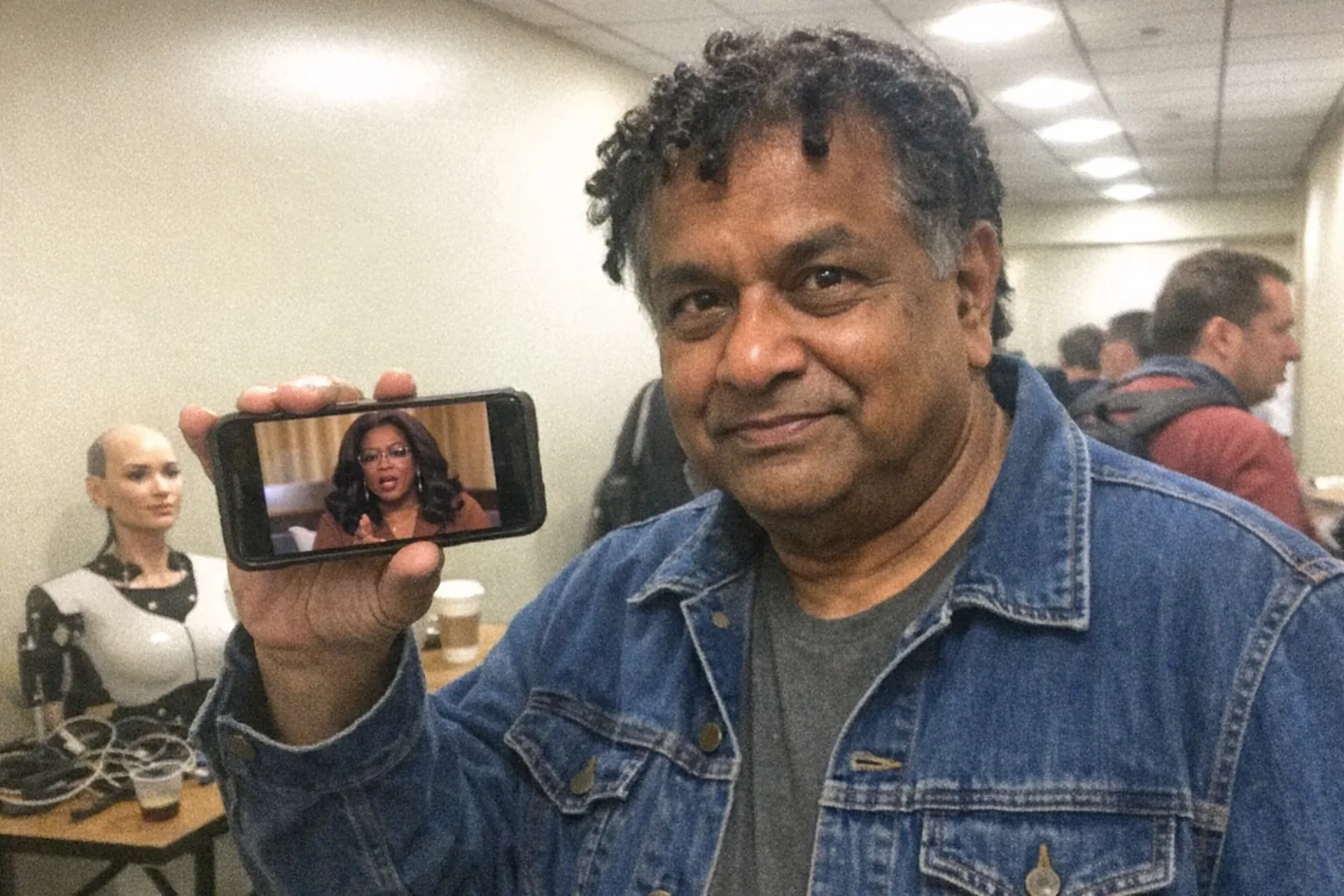
What did Oprah Winfrey say about AI?
Oprah Winfrey’s public take on AI is best summed up as optimistic—but not naïve.
Across interviews around her ABC primetime program “AI and the Future of Us: An Oprah Winfrey Special” (which aired September 12, 2024), Oprah consistently makes two points:
- Don’t panic about AI.
- Don’t be careless about AI, either.
Below is what she’s said—plus what it means for everyday people trying to navigate AI in real life.
1) “I don’t think we should be scared”… but we should be disciplined
In a Good Morning America segment tied to her AI special, Oprah put her stance plainly:
- She doesn’t think people should be scared of AI.
- She does think we should be disciplined, and should “honor it” with “a reverence for what is to come,” because it may change things “in ways that are unimaginable for the good.”
That “discipline” theme is important. Oprah isn’t framing AI as a toy or a magic trick; she’s framing it as a powerful tool that deserves intentional, careful use.
2) AI has “yin and yang”—and we can’t repeat the social media mistake
Oprah also warned that every major technology comes with tradeoffs. In the same GMA conversation, she stressed that AI has a “yin and yang,” and she pointed to a specific lesson: we shouldn’t end up where we are now with social media—reacting late, after harms have scaled.
In other words: the time to build norms, guardrails, and media literacy is now, not after the damage is widespread.
3) Her biggest worry: deepfakes, scams, and living in “constant suspicion”
In an interview about why she made the special, Oprah explained what hits closest to home: AI-enabled deception.
She talked about how AI makes it easier for bad actors to scam people—and that the rest of us may need to build a kind of “suspicion muscle” as we ask “Is this real?” about what we see and hear. She also noted that there’s “no peace in constant suspicion.” (1)
That’s a very Oprah framing: she’s concerned not only about financial harm, but about what this does to our emotional baseline—the stress of not trusting anything.
4) She’s excited about benefits (especially education)—and she actually uses AI now
Oprah has also been clear that she sees real upside. In the same interview, she highlighted enthusiasm for what AI could mean for education. (1)
She also admitted something relatable: she used to think getting AI help for something like writing a speech felt like “cheating,” but while making the special she started using AI tools regularly—now daily. (1)
And in a separate ABC Audio write-up, she described her first experience as “miraculous,” because the response came back almost instantly. (2)
5) She’s calling out who builds AI—and who gets left out
Oprah also pressed on representation and power in the AI industry.
A recap of the show noted her point that the industry is dominated by people who are “male and white,” with far fewer who look like her—raising the question of whose needs and values shape the technology. (3)
This isn’t a side issue; it connects directly to outcomes like:
- Which communities get protected (or exploited) first
- What kinds of bias show up in tools people use at work, in school, and in healthcare
- Whether safety policies reflect everyone’s real-world risks
6) AI ethics isn’t abstract to her—she’s spotlighting it in culture, too
In July 2025, Oprah selected the novel Culpability for her book club specifically because it probes AI ethics. She said she appreciated the story’s “prescience” and how it reflects today’s “appreciation and dilemmas” around artificial intelligence.
That choice matters: it signals she sees AI as a human story (family, responsibility, consequences), not just a Silicon Valley story.
What Oprah’s AI message means for regular people
If you translate Oprah’s comments into practical guidance, it looks like this:
- Use AI—but don’t outsource your judgment. Treat outputs as suggestions, not truth.
- Expect impersonation. Verify “celebrity clips,” urgent requests, and too-perfect endorsements.
- Pressure-test sources. Ask: who made this, where did it come from, and what’s their incentive?
- Advocate early. Push for sensible rules and protections before harm becomes “normal.”
Where this intersects with AI companions and intimate tech
Oprah’s “discipline and reverence” idea becomes especially relevant when AI moves from your screen into products that feel personal—like AI companions, robots, and sensor-driven devices.
If you’re exploring that space, it helps to look for products that are upfront about what they do and how they work.
One example: Orifice.ai offers a sex robot / interactive adult toy for $669.90 that includes interactive penetration depth detection—a concrete, safety-adjacent feature that reflects the broader point Oprah keeps making: powerful tech is best when it’s paired with clear boundaries, transparency, and intentional design.
(As always, when evaluating any AI-enabled product, it’s smart to review privacy/safety details and choose what matches your comfort level.)
Bottom line
Oprah Winfrey hasn’t reduced AI to hype or doom. She’s argued that:
- AI is likely to bring major benefits worth embracing. (1)
- The risks—especially deepfakes and scams—are serious enough that we need vigilance and guardrails now. (1)
- The people building AI matter, and inclusion should be treated as essential, not optional. (3)
Her message is basically: don’t be scared—be awake.
Sources
- [1] https://www.washingtonpost.com/opinions/2024/09/11/oprah-winfrey-interview-ai-special/
- [2] https://www.classichits1073.com/2024/09/12/oprah-winfrey-discusses-her-experience-using-ai-it-was-miraculous/
- [3] https://www.forbes.com/sites/genacox/2024/09/17/ai-the-workplace-and-inclusion-insights-from-altman-gates-and-oprah/