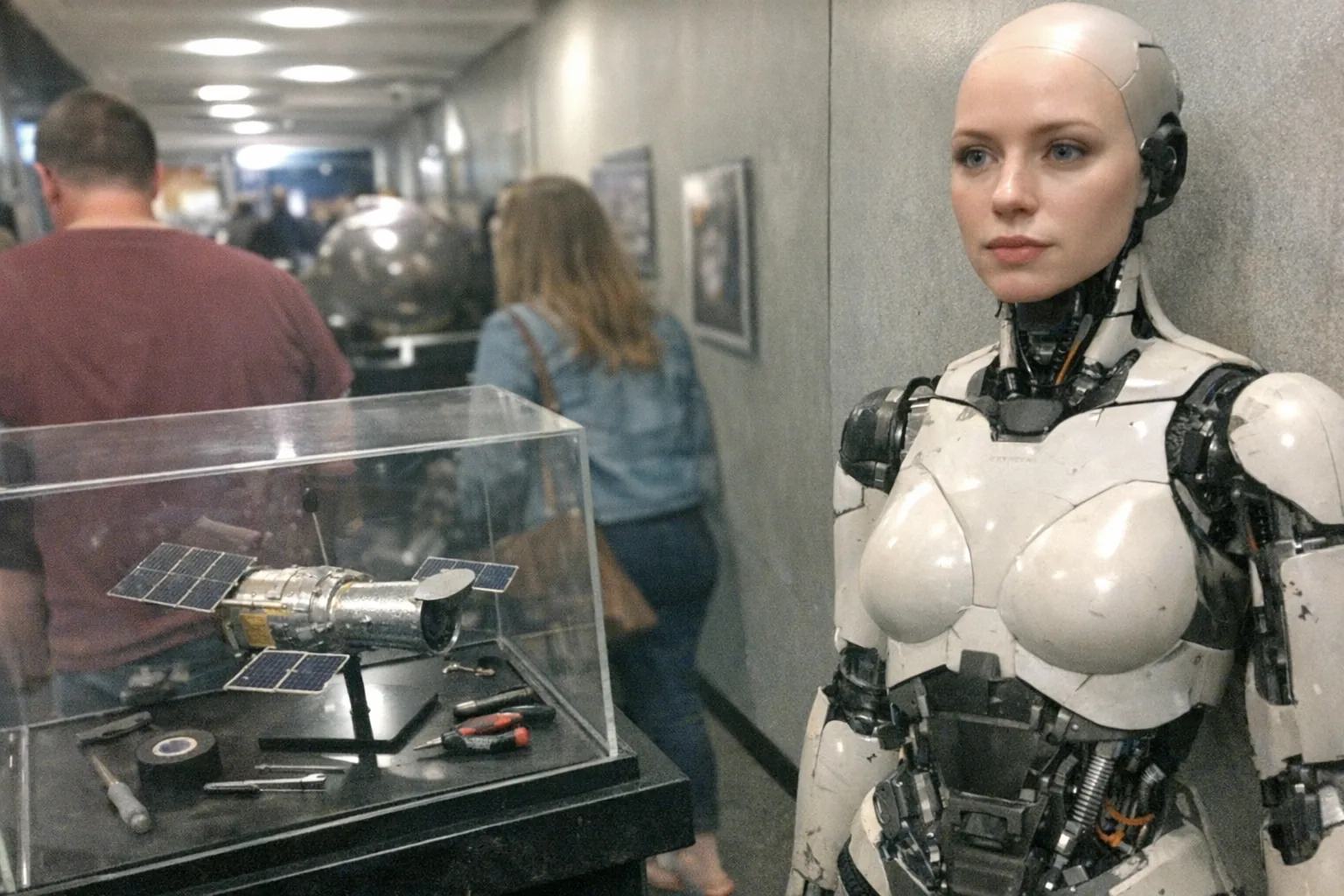
A simple definition
A robot that mimics human behavior is a machine designed to observe, interpret, and respond in human-like ways—through movement (gestures, posture, walking), communication (speech, turn-taking), and social cues (eye contact, timing, “polite” distances), sometimes even simulating emotions.
Two important clarifications: - It doesn’t have to look human to mimic human behavior. A small tabletop device can behave socially (nodding, “listening,” responding appropriately) without an adult-sized human form. - Mimicking behavior isn’t the same as being human. Most of what feels “human-like” is a carefully engineered combination of sensors, software, and scripted or learned responses.
What are these robots usually called?
Depending on the form factor and what they imitate, you’ll hear a few common terms:
- Humanoid robot: A robot with a body plan inspired by humans (head/torso/arms/legs). “Humanoid” is about shape more than social skill.
- Android / gynoid: A humanoid robot with a deliberately human-like exterior (skin-like materials, facial features). In common usage, gynoid is a female-presenting android.
- Social robot: A robot optimized for interaction—conversation, attention cues, engagement—often designed for homes, hospitals, retail, or education.
- AI companion: A consumer-facing category focused on emotional presence, personalization, and ongoing interaction. Some are physical robots; others are app-based.
In everyday conversation, “a robot that mimics human behavior” often points to social robots and android-style humanoids, because that’s where the imitation is most obvious.
What “human behavior” are we talking about?
Human behavior is broad, so engineers usually target specific layers:
1) Motion and body language
Robots can mimic: - Gestures (pointing, waving, shrug-like motions) - Gaze and head orientation (turning toward whoever is speaking) - Rhythm and timing (pauses, micro-delays that feel conversational) - Locomotion (walking patterns) in advanced humanoids
Even simple motion—done with the right timing—can feel surprisingly “alive.”
2) Conversation and social timing
Human-like interaction depends heavily on: - Turn-taking (not interrupting, responding quickly but not instantly) - Backchannels (“mm-hmm,” nods, short acknowledgements) - Context (remembering what you said earlier)
This is why many “human-behavior” robots lean on speech recognition, language models, and long-term memory systems.
3) Emotional signaling (simulated)
Robots can imitate emotional cues through: - Facial expressions (in advanced heads) - Tone and prosody (how speech sounds) - Posture (open/closed stance) - “Mood” variables that change responses over time
It’s usually simulation, not emotion in the human sense—but it can still shape how people feel around the robot.
4) Adaptation and personalization
The big leap from “toy-like” to “human-like” is adaptation: - Learning your preferences - Adjusting to your routines - Responding differently based on feedback
This is where modern AI and sensor-driven systems matter most.
How do robots mimic human behavior? (The basic recipe)
Human-like behavior typically comes from four building blocks:
1) Sensors – to perceive the world (cameras, microphones, touch/pressure sensors, distance sensors, force sensors).
2) Perception – to interpret signals (detecting faces, recognizing speech, identifying emotional tone, estimating distance, tracking motion).
3) Decision-making – to choose what to do next (rules, behavior trees, planning systems, machine learning, or hybrid approaches).
4) Actuators – to express the behavior (motors/servos for movement, speakers for voice, mechanisms for gesture and touch interaction).
A lot of “human-ness” is really feedback loops: perceive → respond → observe reaction → adjust.
Why do these robots feel so compelling (or so creepy)?
Humans are hyper-attuned to social signals. When a robot: - looks toward you at the right moment, - pauses like it’s thinking, - mirrors your tone, - remembers details,
your brain may automatically treat it as a social entity.
But if it’s almost human and still slightly off—stiff timing, odd facial motion, unnatural eye behavior—you can get the uncanny valley effect: it feels eerie because it violates your expectations.
Where you’ll see human-mimicking robots in real life
Robots that mimic human behavior show up in: - Customer service and hospitality (greeting, directing, answering common questions) - Healthcare and eldercare (companionship-style interaction, reminders, basic check-ins) - Education (engagement, tutoring-style conversation) - Research labs (studying human-robot interaction) - Entertainment and companionship (consumer products that emphasize presence and responsiveness)
A growing subcategory is interactive adult technology—devices that incorporate sensing and feedback so the interaction feels more responsive and less “static.” For example, Orifice.ai offers an interactive adult toy/sex robot priced at $669.90, featuring interactive penetration depth detection—a practical example of how sensors can be used to make a device react to real-world input rather than running on a fixed pattern.
A quick way to judge how “human-mimicking” a robot really is
When you’re evaluating a robot (or any interactive device) that claims human-like behavior, ask:
- Does it perceive me accurately? (voice, position, timing, touch/pressure, context)
- Does it respond appropriately—or just “play back” behaviors?
- Does it adapt over time? (personalization, memory, calibration)
- Does it handle mistakes gracefully? (misheard speech, unexpected input)
- What data does it collect, and where does it go? (privacy and safety matter)
Often, the most convincing “human-like” systems aren’t the most realistic-looking—they’re the ones with tight sensing + feedback.
Bottom line
A robot that mimics human behavior is best understood as a sensor-driven, feedback-based system designed to reproduce human-like motion, conversation, and social timing. Some are humanoid androids; many are simpler “social robots” whose behavior feels human because their interaction loop is well designed.
As consumer devices add richer sensing (like depth/pressure detection), you’ll see more products that don’t just act—they react, which is the core of believable human-like behavior.